
Michigan Release Dates Explained
Michigan does not publish one date that always answers when a state prisoner will leave. The OTIS help system defines two public sentence fields. The Earliest Release Date, often called ERD, is normally the point when the court-imposed minimum has been served and the Michigan Parole Board gains jurisdiction. It is an eligibility point. The Maximum Discharge Date is the outer sentence endpoint shown by MDOC. The department says it cannot keep a prisoner beyond that lawful maximum, but the controlling sentence calculation still matters.
An actual Date Paroled or Date Discharged records an event that has occurred. A future ERD does not. Parole requires a Board decision and release processing after eligibility. If parole is granted, the person may leave prison while remaining in MDOC legal custody. Discharge ends the identified sentence or supervision. Those are not interchangeable outcomes.
A pretrial county detainee often has no sentence-based release date. Bond action, dismissal, a court order, a detainer, or transfer may control the next custody event. A sentenced county jail inmate may have a locally computed date, but OTIS is not the source because it excludes jail-only cases.
Find a Michigan Projected Date
Start by deciding whether the person is in an MDOC prison or a county jail. State-prison sentence fields belong in the Offender Tracking Information System. County dates come from the sheriff and the sentencing court. The MDOC offender search route is most direct when a six-digit MDOC number is known.
- Open the official OTIS landing page and launch the live search.
- Enter the six-digit MDOC number, or search by name and refine the match with identity fields.
- Open the detail record. Confirm the name, aliases, sentencing county, court file number, offense, and MDOC number.
- Read Earliest Release Date and Maximum Discharge Date with the current status and sentence terms.
- For an imminent event, confirm with MDOC, the assigned field office, or the county custodian that now holds the person.
The live OTIS search form shows the identity and status filters used to narrow a match.
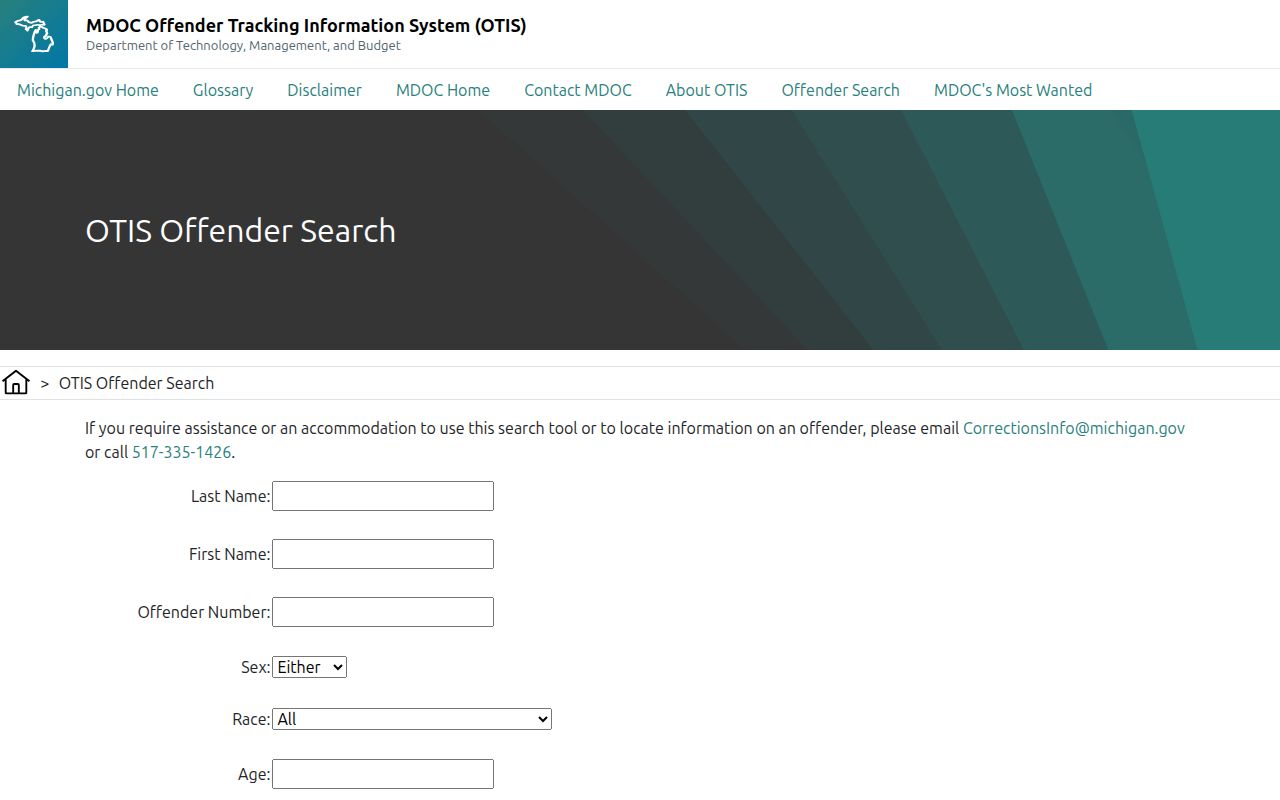
The form is only the first step. A date should be taken from the correct detail record after the identity fields line up.
For a county sentence, contact the sheriff that operates the physical jail and check the court docket. Some small counties house people in another county, so the arresting county and holding jail may differ. Ask for the sentence calculation or booking and release record rather than assuming a missing roster name means release.
Michigan Truth-in-Sentencing Dates
Michigan’s modern truth-in-sentencing framework creates a sharp offense-date line. The MDOC truth-in-sentencing explanation says covered offenders must serve the entire minimum in prison before parole consideration. Good time and disciplinary credits do not reduce that minimum. The rule applies to specified assaultive crimes committed on or after December 15, 1998, and all other crimes committed on or after December 15, 2000.
The official truth-in-sentencing page shows why a modern Michigan inmate projected release date cannot be shortened by applying a broad percentage rule.
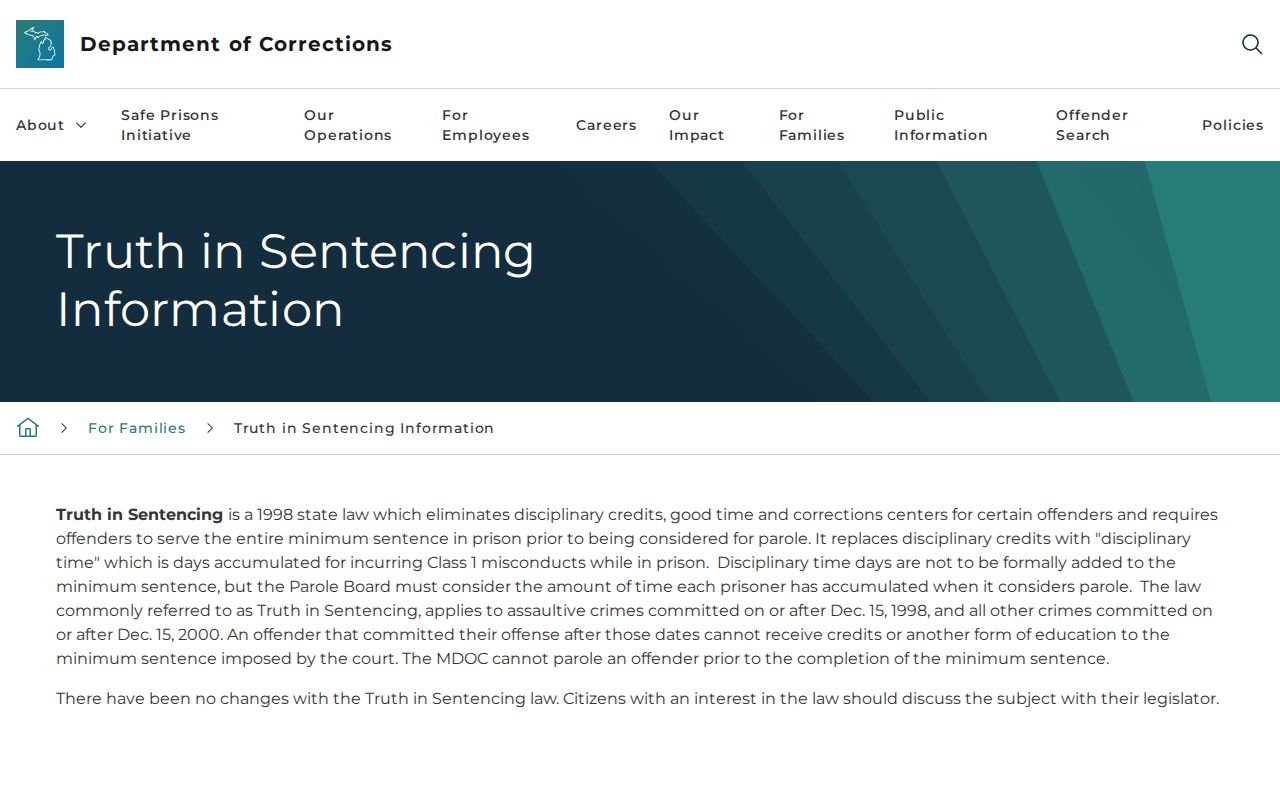
Its key point is service of the full minimum before the ordinary parole decision, not a fixed release at the minimum.
| Sentence setting | How credit affects the date |
|---|---|
| Covered modern MDOC offense | No good-time or disciplinary-credit reduction against the minimum; Class I misconduct produces disciplinary time considered by the Board. |
| Qualifying older MDOC offense | Good time, disciplinary credits, or special disciplinary credits may apply under the offense-date rules in MCL 800.33. |
| Sentenced county jail term | MCL 51.282 permits one day of good-time credit for each six days served for good behavior, subject to forfeiture and restoration. |
| Pretrial county detention | No prison minimum or ERD exists; bond, court action, holds, or transfer control release. |
The date and type of offense select the rule. The date of the search does not. MCL 800.33 preserves older credit systems, while MCL 791.234 sets the Parole Board’s jurisdiction for the relevant sentence class.
Michigan Dates Can Still Change
Even a correctly read OTIS date does not describe every step between sentence calculation and the prison gate. Courts may amend judgments. Consecutive sentences can change the aggregate term. A detainer can send someone to another agency instead of the community. Board action, placement approval, misconduct information, and violation proceedings can also change the event that follows an ERD.
| Factor | Effect on the projected event |
|---|---|
| Parole grant | Starts placement and release processing; it is not proof of same-day departure. |
| Denial or deferral | Leaves the prisoner in custody and sets or anticipates later review within the lawful term. |
| Court amendment | May change the minimum, maximum, concurrent, or consecutive sentence calculation. |
| Detainer or hold | May cause transfer to another county, state, federal, or immigration authority. |
| Disciplinary record | Can affect legacy credits or add disciplinary time for Board consideration. |
| Release plan | Placement review and administrative work can separate a positive decision from physical departure. |
The MDOC Parole Board reports group grants, denials, and deferrals, which helps show that eligibility and outcome are separate measures.
A grant in an aggregate report is a Board result. The individual Date Paroled remains the stronger public marker of completed prison release.
Note: A transfer ends one facility placement but continues custody, so it should not be reported as a community release.
Older Michigan Good-Time Cases
Older Michigan sentences demand more care because several credit systems may survive based on the offense date and statutory category. MCL 800.33 addresses good time, disciplinary credits, special disciplinary credits, and disciplinary time across different periods. MCL 791.234 links those lawful credits to the point when the Board gains jurisdiction for an indeterminate prisoner who is not subject to modern disciplinary time.
Do not subtract a credit by hand and publish the result as a release date. The public OTIS fields reflect MDOC’s working sentence computation, and a certified or disputed calculation belongs with MDOC records and the sentencing court. A case with a life term or an offense-specific restriction may not follow the ordinary minimum-to-maximum path at all.
- Minimum term
- The court-set period tied to the ordinary start of Parole Board jurisdiction.
- Earliest Release Date
- The public OTIS eligibility milestone, not a release appointment.
- Maximum Discharge Date
- The outer sentence endpoint shown by MDOC under the controlling computation.
- Detainer
- A request or legal basis for another authority to take or keep custody.
The OTIS scope page also explains who is and is not in the public system.
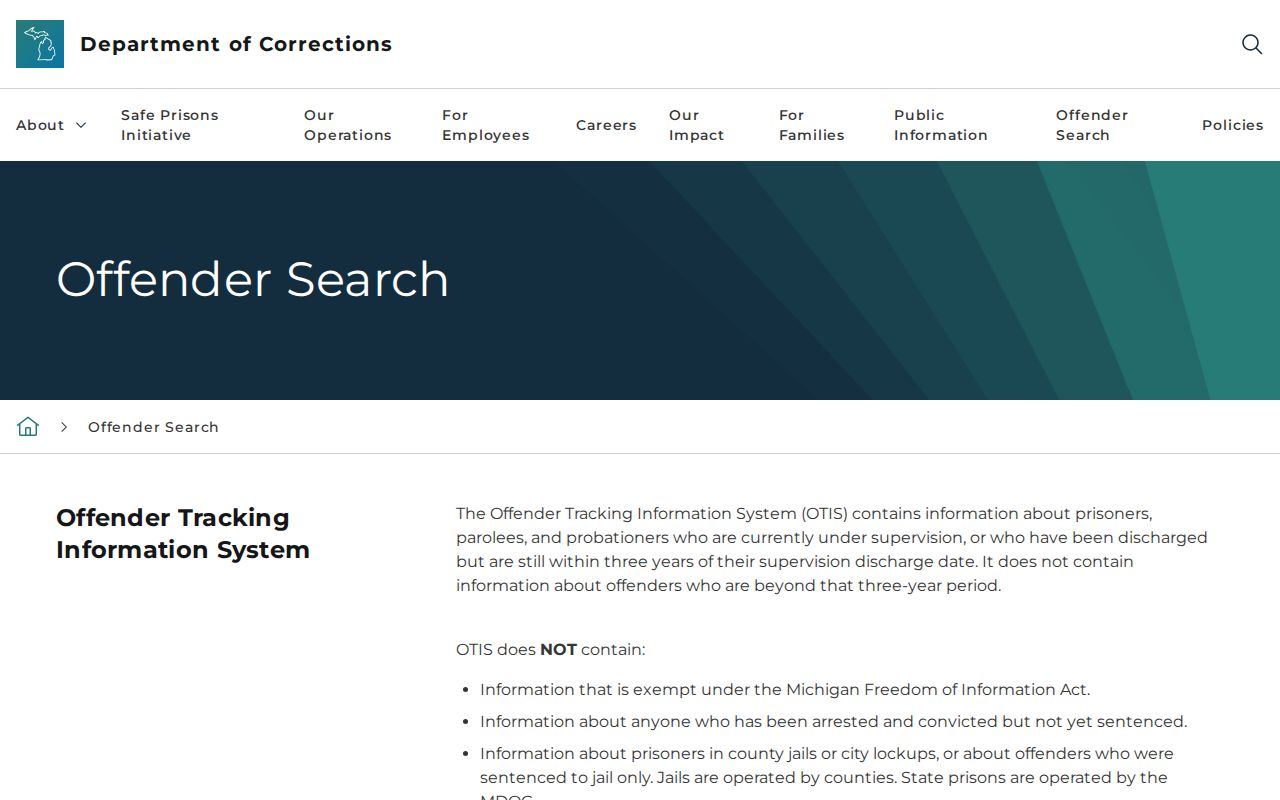
That scope matters in older cases because people discharged from supervision more than three years ago are normally no longer shown.
Michigan Weekend Discharge Dates
Michigan’s discharge policy has a precise timing rule. When a lawful discharge date falls on a Saturday, Sunday, or holiday, discharge occurs on that date. It does not shift by default to the next business day. That detail concerns discharge at the end of the sentence or supervision and should not be turned into a broad claim that every parole release happens on weekends.
Cooper Street Correctional Facility in Jackson identifies itself as a release facility for prisoners nearing parole, discharge, or community placement. It is an important statewide processing point, but Michigan does not state that every MDOC release occurs there. The current institution and release plan must still be checked on the person’s record.
The official Cooper Street profile describes its release-facility role. MDOC discharge policy supplies the weekend and holiday rule.
Note: A facility’s release role does not prove that a named person will leave from that location.
Michigan County Jail Dates
A county jail date follows a different chain. First determine whether the person is awaiting trial or serving a local sentence. A pretrial detainee has no MDOC minimum, ERD, or maximum discharge date. The next event may depend on bond, a hearing, dismissal, a plea, a new order, or another agency’s hold. The court docket may show the legal authority, while the sheriff records the physical custody event.
For a sentenced jail term, MCL 51.282 authorizes the sheriff to credit one day for each six days served for good behavior. The statute also addresses forfeiture after misconduct and restoration. That computation belongs to the county custodian. It cannot be copied onto a state-prison sentence, and it does not turn a live jail roster into a projected-date calculator.
Ask the sheriff for the commitment dates, jail credit, good-time computation, current holds, and expected release event. Ask the sentencing court about the judgment or later order. If the person is housed for another county, contact the operator of the physical jail as well as the court that imposed the sentence.
Read Michigan OTIS Dates Together
One OTIS field can mislead when read alone. Match the Earliest Release Date to the minimum sentence, current status, assigned location, and any Date Paroled. Then compare the Maximum Discharge Date with the maximum term and any Date Discharged. This sequence separates a future eligibility point from a completed prison exit and a later end of supervision.
Suppose an OTIS record shows an ERD in the past but still lists a prison location. The date does not prove that release was missed or delayed. It can mean the Board had jurisdiction but did not grant parole, deferred review, or that another legal rule applied. If the status is PAROLE and Date Paroled has passed, the person has left the prison placement under MDOC’s definition but remains under supervision. A DISCHRG entry with Date Discharged marks the later end of MDOC jurisdiction.
A projected release query may also surface the maximum date first. Treat it as the sentence endpoint, not the most likely release day. Many eligible people can be paroled before that point, while some remain until maximum discharge. OTIS cannot replace a current release plan, Board notice, or sentence computation when the date is disputed.
Which date confirms release? Use Date Paroled for the recorded prison-to-parole event and Date Discharged for termination of the identified MDOC term. A future ERD confirms neither event.
Confirm Michigan Release Events
For a future state-prison event, compare the current status, ERD, maximum date, assigned location, and any Board action. Then confirm the event with MDOC or the listed field office. For a county jail sentence, use the sheriff and court. If another hold appears, contact the authority that now has custody.
A Michigan VINELink check can add a release or transfer alert when the relevant system participates. It does not certify the event. The agency record remains the source for the actual timestamp, reason, destination, and legal status after release.
The state offender search and MI-VINE serve different roles. OTIS supplies sentence and status fields for MDOC cases. MI-VINE follows notification events in participating systems. Neither one turns an estimated date into a guarantee.
A past OTIS Date Paroled is evidence that MDOC recorded departure from prison or placement on parole under its definition. It does not say that supervision ended. A past Date Discharged addresses the end of the identified MDOC term. For exact timing, release reason, or discharge paperwork, request the department record.
If the person disappears from one locator before another updates, check for transfer first. A county-to-MDOC move, an MDOC-to-county writ, and an exit to federal or immigration custody all keep the person confined somewhere. The next agency’s record should be matched before the event is called a release.