
MDOC Release Record Scope
MDOC is the Michigan Department of Corrections. It operates the state prison system and supervises people on state parole and felony probation through Field Operations Administration. The agency is also the custodian for its prison, supervision, parole, and discharge records. County sheriffs operate local jails, so MDOC is not the source for a person whose case never entered state corrections jurisdiction.
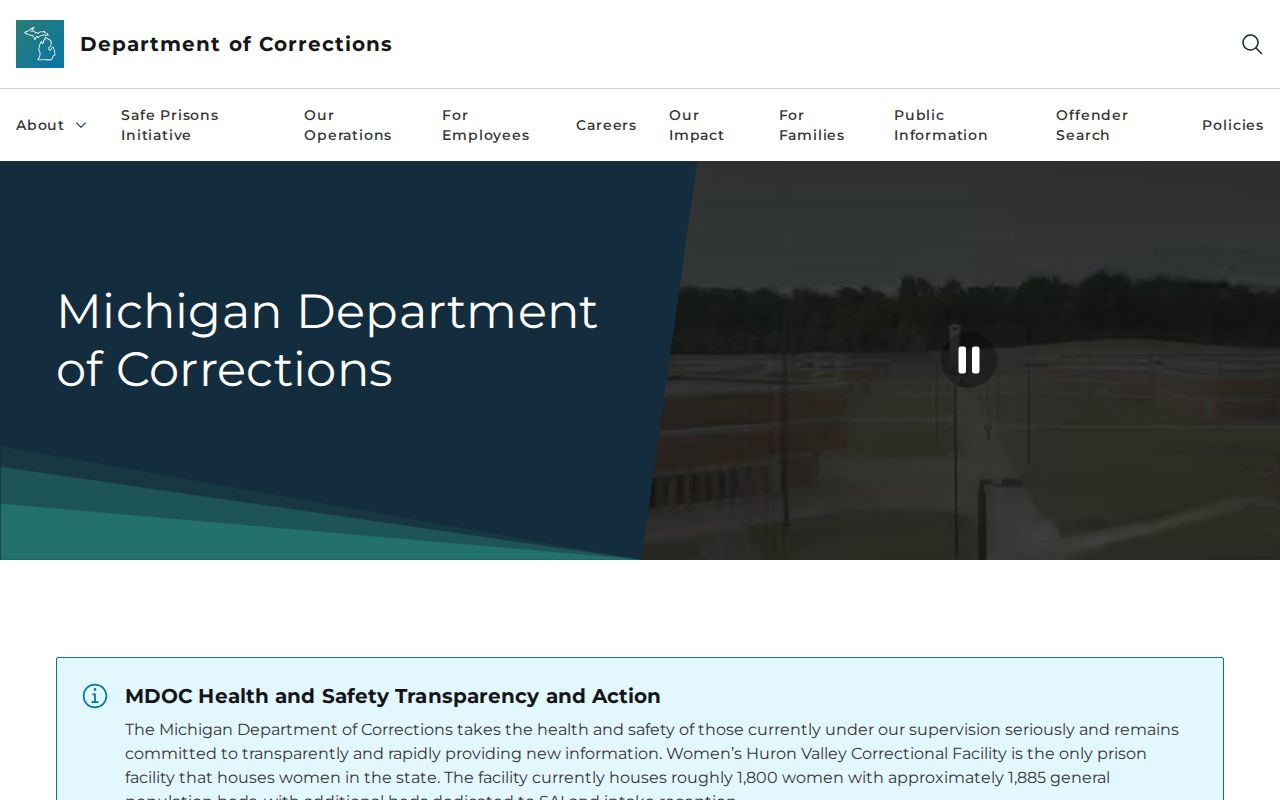
The official MDOC home page establishes the department’s identity and statewide role.
OTIS draws largely from court and departmental records, but the public detail is not the full corrections file.
A person may leave a county jail on bond, after dismissal, at the end of a jail term, or through transfer. Only a path into MDOC custody or supervision should ordinarily create an MDOC entry. In the other direction, parole releases a prisoner from a prison placement while the sentence continues under MDOC control. Under MCL 791.238, parole is permission to leave prison, not the end of legal custody.
Use the MDOC Offender Search
The public MDOC offender search is the Offender Tracking Information System, or OTIS. It includes current prisoners, parolees, and probationers under MDOC supervision, plus people discharged within three years of the supervision discharge date. Search the six-digit MDOC number first when known. It is more reliable than a common name.
- Open OTIS from the official MDOC landing page and continue to the live form.
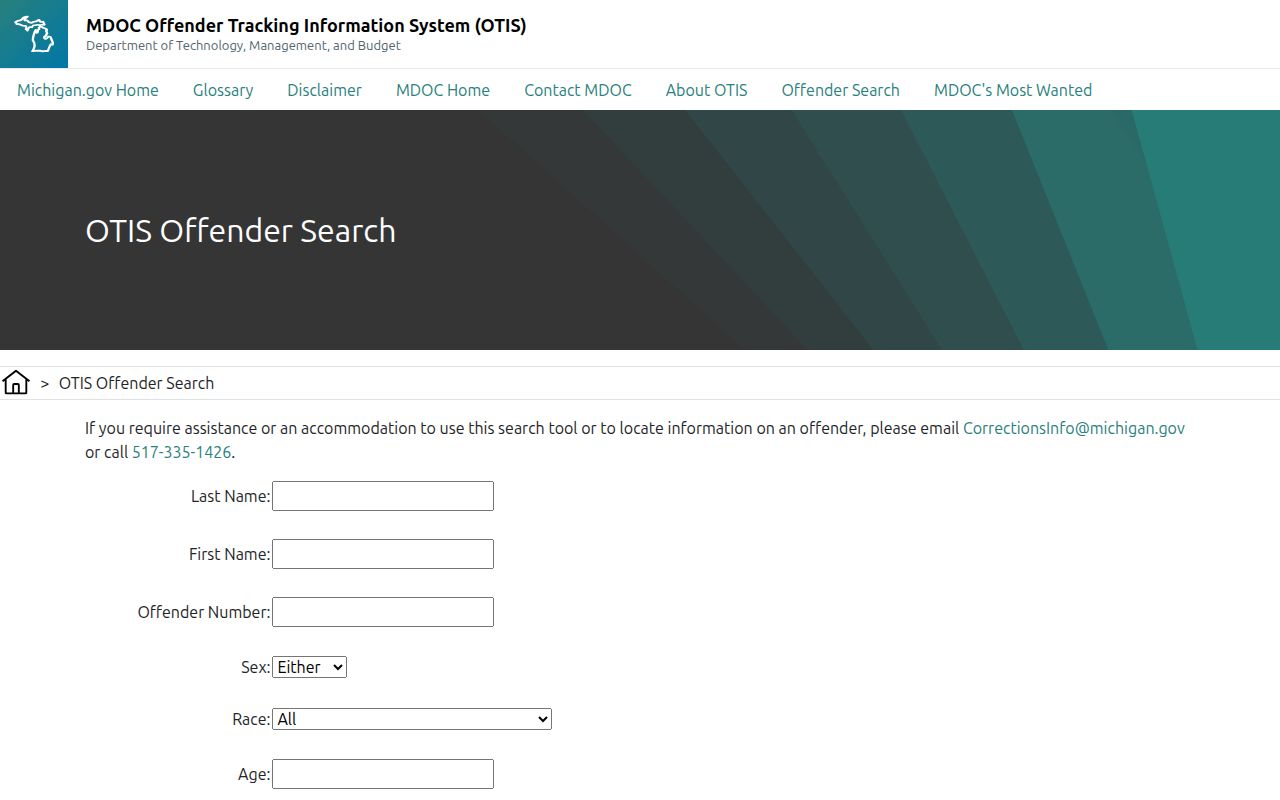
- Enter the MDOC number, or use last name and first name or initial.
- Refine carefully with status, age, sex, race, marks, or location fields when needed.
- Open a candidate and match aliases, court file number, sentencing county, offense, and physical identifiers.
- Read the current status with Date Paroled, Date Discharged, ERD, and Maximum Discharge Date.
The live OTIS form presents the search inputs and status filters.
Try a former name or alias when the expected record does not appear, but never use a photograph alone to settle identity.
For a person believed to have completed MDOC jurisdiction, include discharged status in the search. A no-result may mean a spelling mismatch, a jail-only case, a not-yet-sentenced case, a record beyond the public window, a set-aside conviction, or a person outside MDOC authority. It is not proof that the person was never incarcerated or has been released.
When the entry is older than the public window, move from search to records. The sentencing court can confirm its judgment and case number. MDOC can route past-prisoner records and respond to a specific FOIA request. Michigan State Police ICHAT addresses a broader criminal-history question, but it is not a substitute for an MDOC release or discharge document.
Also check whether the person was known only to a county jail. OTIS expressly excludes prisoners in county jails or city lockups and people sentenced only to jail. Searching those names again with broader OTIS filters cannot overcome the jurisdiction limit.
MDOC Offender Search Fields
A released or supervised OTIS detail must be read field by field. PAROLE means the person has left prison but remains under MDOC legal custody and supervision. PROBATION describes a court-ordered community sentence and may not follow a prison release. DISCHRG means the identified MDOC sentence or supervision has ended. A location change alone does not establish a new release.
| Field | What It Shows |
|---|---|
| MDOC number | The six-digit department identifier used to distinguish people and records. |
| Status | Prison, parole, probation, or DISCHRG status within the OTIS vocabulary. |
| Date Paroled | The date MDOC says the person left prison or camp, or was placed on parole under another secure-custody arrangement. |
| Date Discharged | The later termination of sentence or supervision, often shown with a discharge reason. |
| Earliest Release Date | The ordinary minimum-term milestone when the Board obtains jurisdiction, not a promised departure. |
| Maximum Discharge Date | The outer sentence endpoint under MDOC’s sentence calculation. |
| Sentence and court fields | Offense, terms, sentencing county, and court file number used to verify the case. |
| Location and identifiers | Assigned prison or field office, aliases, description, marks, and an available photograph. |
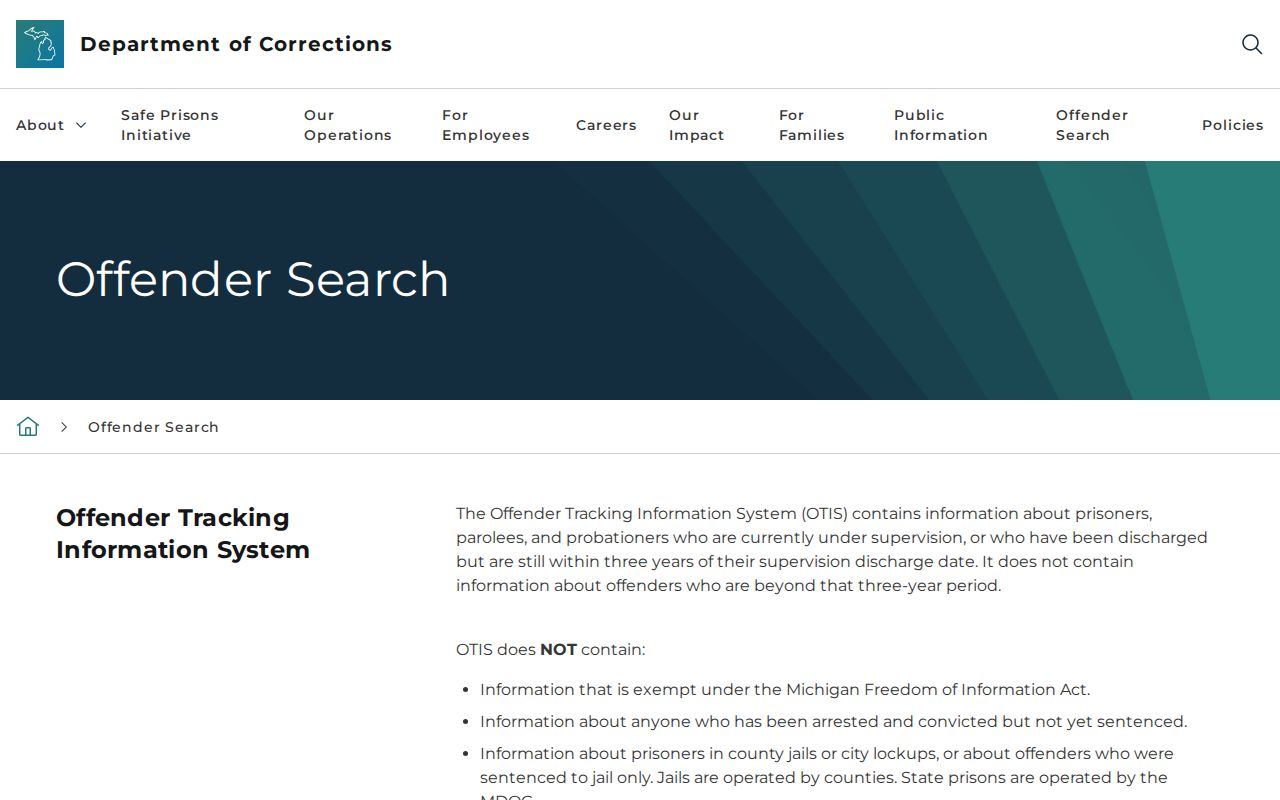
The OTIS landing page explains its exclusions and three-year post-discharge boundary.
Not all fields are populated. Exact proof belongs in an MDOC record request, not an uncited screenshot.
Michigan Parole Versus Discharge
Michigan generally uses indeterminate prison sentences with a minimum and maximum. The Michigan Parole Board ordinarily gains jurisdiction at the Earliest Release Date. It may grant parole at or after that point when the law permits and the Board approves. A positive decision goes to the Parole Release Unit, which documents the date, term, and special conditions and coordinates placement. Physical departure can follow later.
If parole is not granted during the lawful term, the prisoner reaches maximum discharge when the maximum expires. MDOC says it has no authority to imprison someone beyond that maximum. A discharge from parole or probation is a different event: it closes community supervision and ends MDOC jurisdiction for the identified sentence.
- Parole
- Conditional release from prison while the person remains in MDOC custody and under supervision.
- Discharge
- Termination of the identified sentence or supervision and the corresponding MDOC jurisdiction.
- ERD
- The earliest release or Board-jurisdiction date, not a guaranteed release date.
- Detainer
- A legal hold that can result in continued custody or transfer to another authority.
Michigan does not use a simple statewide mandatory-release label that promises release at one fixed percentage. Parole eligibility, discretionary Board action, and maximum discharge are the accurate terms. Specialized life sentences and offense-specific categories require their own analysis under MCL 791.234.
MDOC Sentence-Date Rules
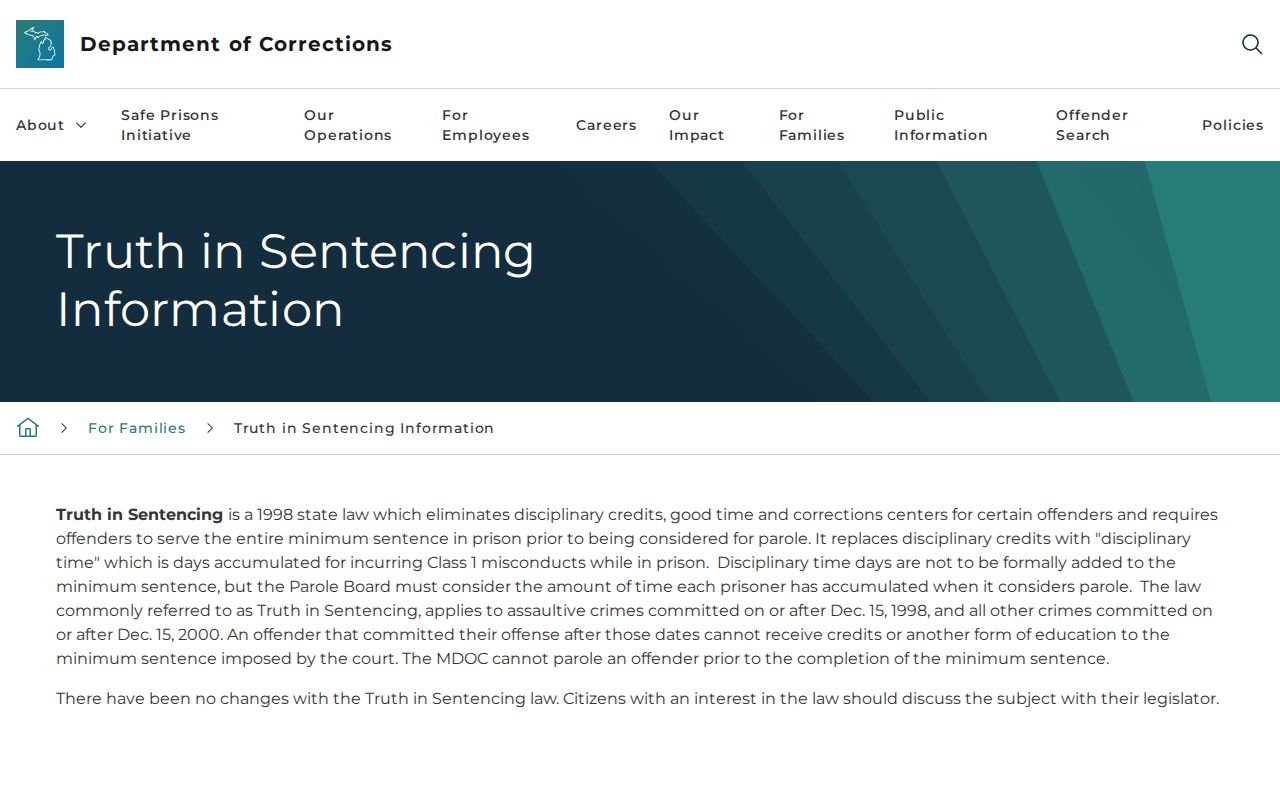
Michigan’s truth-in-sentencing rules govern modern minimum terms. Covered assaultive offenses committed on or after December 15, 1998, and all other covered offenses committed on or after December 15, 2000, require service of the full minimum before parole consideration. Good time and disciplinary credits do not reduce that minimum. Class I misconduct can create disciplinary time for the Board to consider.
Older cases may remain subject to good time, disciplinary credits, or special disciplinary credits under MCL 800.33. The offense date and legal category control. A county jail’s separate good-time statute cannot be applied to an OTIS prison date.
The MDOC truth-in-sentencing page sets out the modern framework.
That framework is why an ERD is not a promise and why two similar-looking sentences may compute differently.
Note: Never calculate an MDOC release date by applying a generic percentage to the sentence.
MDOC Release Processing Locations
MDOC releases can begin from institutions across Michigan, followed by the placement and records work suited to the person’s case. Cooper Street Correctional Facility in Jackson specifically identifies itself as a release facility for prisoners nearing parole, discharge, or community placement. That role does not mean every state-prison release occurs there.
For a named person, use the current OTIS location, the release plan, and agency confirmation. A transfer to another prison, county jail, federal authority, or immigration custodian is continued custody. It is not a release to the community. Reception and health facilities also have different roles from a release facility.
The Cooper Street profile supports the specific release-facility description. The statewide Michigan Facility Directory separates MDOC prisons from county, federal, and immigration custody sites.
Michigan discharge policy also says a lawful discharge date that falls on a weekend or holiday occurs on that date. It does not move by default to a later business day. That is a discharge rule, not a claim about the daily timing of all parole releases.
MDOC Release Trends Differ
Recent Michigan measures show why a parole grant rate and the number moving to parole are not the same. MDOC’s March 2025 projection report says moves from prison to parole rose 5.7% from 2023 to 2024. The reported grant rate fell 0.6%, yet Board decisions rose 10.6%. More decisions can yield more paroles even when the share granted edges down.
The year-end 2024 prison population was 32,778, compared with a March 2007 peak of 51,554. Prison intake fell 6.0% during 2024, and the year-end population was 208 lower than a year earlier. These are dated statewide counts and movements. They are not a live count of MDOC released inmates or the number of people who ended all supervision.
The MDOC legislative reports archive also publishes quarterly Board decision reports.
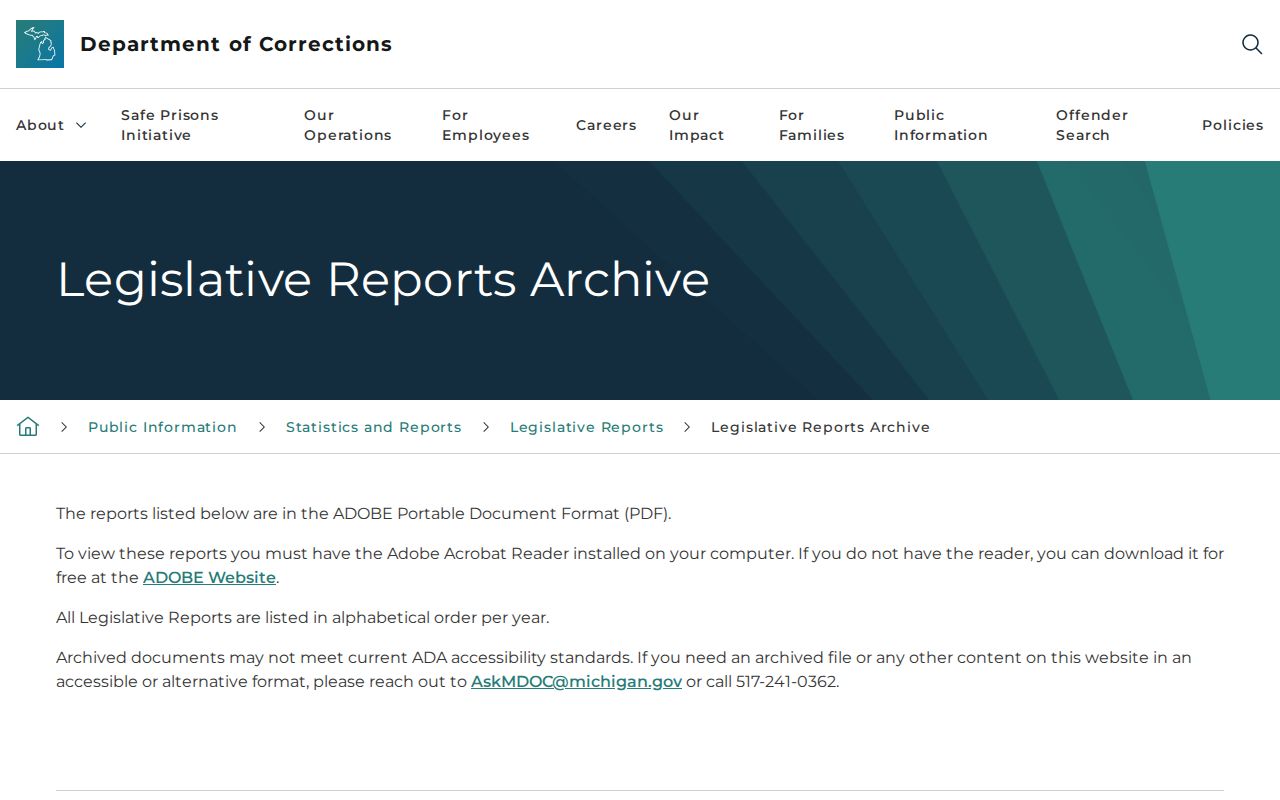
A grant in those aggregate reports is a decision outcome, not proof that the person physically left prison on the hearing date.
MDOC Versus County Releases
The MDOC offender search is the statewide authority for covered state-prison and supervision records. It is not a broad Michigan jail roster. A sheriff holds the booking and release record for its jail. The sentencing court holds the docket and order that may have authorized bond, dismissal, time served, probation, or another result.
| Question | MDOC state case | County jail case |
|---|---|---|
| Who is covered | State prisoners, parolees, felony probationers, and recent discharges in scope | Pretrial detainees and people serving local jail terms |
| Who records release | Michigan Department of Corrections | Physical county sheriff and the relevant court |
| Where to look | OTIS status and event dates, followed by MDOC records | Current roster, booking or release record, and court docket |
| What absence may mean | Outside jurisdiction, beyond retention, mismatch, or legal removal | Release, transfer, another hold, or a local data limit |
If a sheriff transferred someone to MDOC after sentencing, the county exit is not a community release. It is a transfer into state custody. Search OTIS after intake data is available. If OTIS never covered the case, route the inquiry to the correct sheriff through the County Directory.
MDOC Discharge-Day Assistance
Michigan discharge policy provides a careful, conditional form of release assistance. MDOC provides clothing. When a person lacks visible support and has reasonably conserved available funds, the policy allows a total of up to $75 from the person’s own balance plus an institutional difference. This is not a universal promise of $75 in gate money.
When the person cannot arrange transportation, the policy provides the most economical public transportation to an appropriate destination under its rules. Parole follows a different release-funds rule, so discharge assistance should not be applied to every person leaving prison. The person’s sentence status and release route control.
The MDOC discharge policy is the source for these conditions. It should be rechecked when planning for a current discharge.
Note: Release assistance depends on policy conditions and the person’s own circumstances, not merely a DISCHRG label in OTIS.
MDOC Discharge Certificates
OTIS is a public, time-limited view. Durable proof comes from the departmental record. MDOC policy calls for a discharge certificate or order and closes the departmental database record when a sentence terminates. The public OTIS entry normally remains searchable for three years after the supervision discharge date, so public display and record retention are different concepts.
MDOC’s FAQs describe a certified PENPACK that may include specified correctional documents, including a discharge certificate. That route is restricted to duly recognized criminal-justice authorities conducting official business. It is not a general-public shortcut. A member of the public should use an ordinary, well-described records or FOIA request.
MDOC directs corrections to their proper source. A court-derived conviction or sentencing error belongs with the sentencing court. A supervision error, such as an incorrect absconder status, belongs with the supervising office. MDOC says OTIS information is removed after a set-aside, expungement, or operation of law, apart from the ordinary display window.
A discharge certificate answers a different question from an OTIS status screen. The certificate documents the department’s formal termination process. OTIS helps the public locate a recent entry and see its displayed dates. When the public entry ages out, the underlying record does not become a fresh release, nor does the disappearance itself prove expungement.
Requesters should name the exact document and approximate discharge date. They should also distinguish a discharge from prison at the maximum term from discharge after parole or probation. That wording helps MDOC locate the right part of the record and reduces the chance that a broad request returns only a public printout.
Request MDOC Release Records
Michigan FOIA is 1976 PA 442, MCL 15.231 through 15.246. A written request must describe the desired public record well enough for MDOC to find it. No universal special form is required, and an email or fax can qualify as a writing. The public body generally has five business days after legal receipt to grant, deny, partially grant, or invoke one extension of up to ten business days. Exemptions, redaction, and permitted fees still apply.
- Identify the person, aliases, six-digit MDOC number, approximate dates, facility, and sentencing county.
- Name the exact record, such as admission and release timestamps, parole order, discharge certificate, sentence calculation, or release destination.
- Send the request to MDOC’s FOIA process by email at MDOC-FOIA@michigan.gov or by the listed mail or fax route.
- Review any fee estimate, partial denial, exemption, or redaction explanation before narrowing or appealing the request.
The official records-request page shows MDOC’s current request channel.
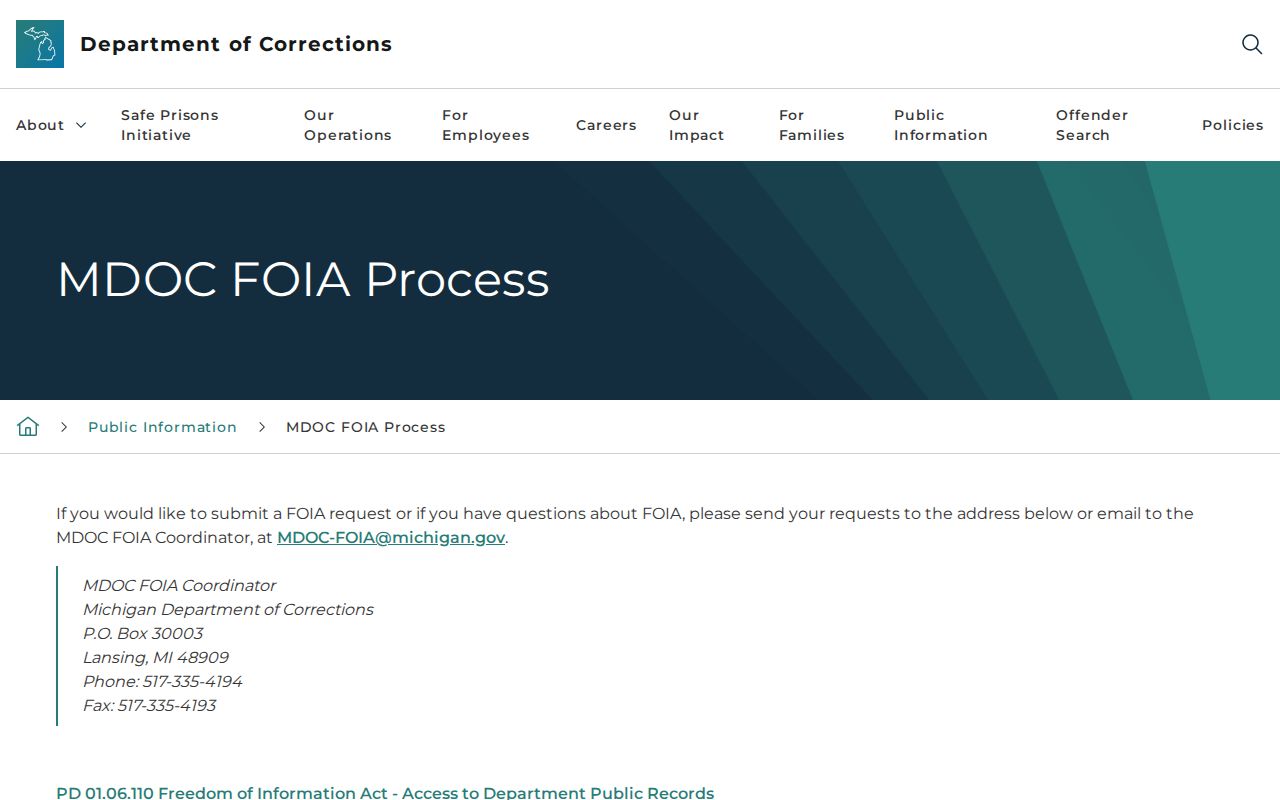
MDOC lists its FOIA coordinator at P.O. Box 30003, Lansing, Michigan 48909, telephone 517-335-4194, and fax 517-335-4193.
The department separately routes current-prisoner records and past-prisoner records up to six years post-release through its Contact Us page. That records-routing period does not extend OTIS’s three-year public-search window. For a certified need, state the record and form of copy sought instead of asking for “everything.”